Overcoming “What If” Thinking
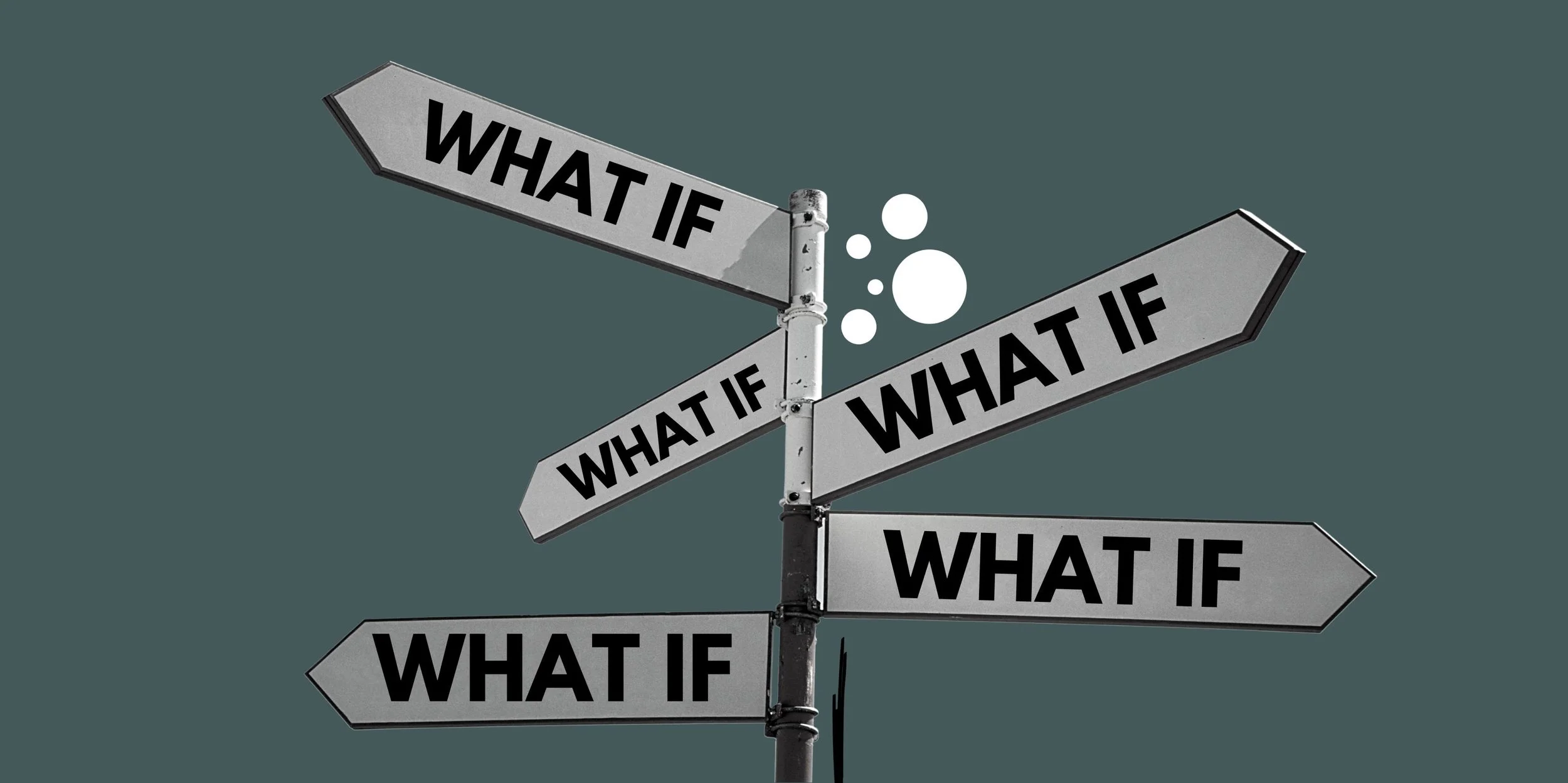
Origin of “What-if” Thinking
As we go through life, we inevitably encounter moments that feel too painful, too overwhelming, or simply too much to handle. As a coping mechanism, many of us develop what-if thinking.
In essence, what-if thinking is the brain’s attempt to predict and prevent future pain before it happens. It’s a strategy designed to keep us safe - to stay one step ahead of uncertainty, discomfort, embarrassment, rejection, loss, or danger.
And at first, this strategy appears to work.
You think, “What if I lose my keys again!?” And you create a solution - “hmm… I’ll check my pockets every thirty minutes, maybe put a spare one under the bin.” Solved! And you feel some peace and calm.
Then another one appears…“What if the elevator gets stuck!?” You think for a while and… “Ah!! I’ll just take the stairs, I need to burn some calories anyway.” Solved. Again, some peace and calm.
Then another one, “What if I say something stupid in the meeting?” So you rehearse what you’ll say beforehand, maybe play out different versions of the scenario and how you’ll respond. Done. Peace and calm.
But because the brain is so resourceful, for every what-if thought you solve, it gives you another three…and before you know it, you have so many what-if thoughts to solve that you go into overwhelm. And what happens when a mammalian nervous system goes into overwhelm? The fight-or-flight response kicks in. You get incredibly anxious… All of a sudden, you’re paralysed.
Now the strategy that was meant to protect you from pain has become the source of pain.
What a pickle.
Why it Never Works…
Why is it that what-if thinking never works in the long run?
It’s because life is shaped by countless variables interacting in ways so complex that no mind can reliably predict what comes next. Life does not behave like a computer or an engine with limited parts that move in predictable ways. For those kinds of systems, what-if thinking works just fine. But life is so dynamic and complex that it’s impossible to predict. Research shows that over 90 percent of all what-if thoughts never actually come true. And out of the ones that do come true, a third of the time reality turns out better than predicted.
In other words, pretty much none of our what-if thoughts are accurate.
If you reflect on your life, you’ll notice this has always been the case. How many times have you spent weeks looking forward to a holiday only to find it wasn’t nearly as fulfilling as you imagined it would be? Or how many times have you anxiously anticipated a conversation or meeting, only to discover it went perfectly fine? Life is filled with countless examples of how our predictions never actually come true. If you step back and look at your life as a whole, it probably hasn’t unfolded even remotely the way you once imagined. Maybe in the larger scheme of things, like career, marriage, kids and the town you live in - maybe!! But the actual path? The details? The way things unfolded moment by moment? Those things have been completely and utterly surprising to you.
So when you really consider it, what-if thinking is pretty useless. And it’s important to admit that to ourselves. No matter how much we try, we don’t know for sure how things will unfold.
As Mark Twain stated, “I am an old man and have known a great many troubles, but most of them never happened.”
From What-if to …Whatever!
So, what are we to do? If what-if thinking doesn’t work, how are we to cope with the inevitable painful things life throws our way? Well, we can try the opposite - letting go (did I hear a ‘gulp’?).
Instead of “what-if, what-if, what-if”, it’s “whatever happens, I’ll handle it.”
I know that sounds scary, but the reality is that up until now, you have already been doing this….you just haven’t been aware that you’ve been doing it. Because despite all the what-if thoughts your mind has generated over the years, life has continued unfolding in ways you could never have fully predicted or controlled. And yet, here you are. The fact that you’re alive reading these words right now is evidence that you already possess the resources needed to handle uncertainty. Think about that! Your whole life is a testament to the fact that no matter what has happened, no matter how challenging or unpredictable - you’ve had the resourcefulness to survive, you’ve made it through.
So, maybe it’s time to trust that you are actually incredibly resourceful and resilient.
Now, with that, we also have to accept that there will indeed be painful events coming our way now and then. It’s built into the very nature of life. You might lose. You may be embarrassed. You might say the wrong thing. You might get sick. Someone might cheat on you. You may get fired. Some of these things are very likely to happen at some point.
But instead of running away from these events, you turn towards them and trust that if they happen, you'll handle them. That’s not to say they will happen - remember, most of your what-if thoughts never come true - but if they do… You affirm to yourself, “Whatever happens, I’ll handle it” or “If that happens… I’ll figure it out, I’ll be okay.”And of course, the chances are that you will be okay, because up until now, your track record of making it through difficult and unpredictable events is extremely good.
When asked if he got nervous about missing a shot before taking it, Michael Jordan replied, “Why would I worry about a shot I haven’t taken yet?”
The Case for Choosing Life.
Ironically, the more you avoid painful events, the more suffering you end up experiencing. Because when you avoid the parties, cancel the trip, take the stairs instead of the elevator, and stay silent in the meetings, etc., the relief feels good in the moment, but you’re also signalling to the brain that those things are indeed a threat. Over time, you become more anxious and withdrawn, and your world shrinks. You become afraid of life. Taken to its extreme, you become full-blown agoraphobic, so anxious that you never want to leave your house.
The strategy that was meant to save you starts to imprison you.
But the opposite of that is also true: the more willing you are to move toward discomfort, uncertainty, embarrassment, failure, rejection, or pain… the less power those things tend to have over you. You realise that, even though those experience are uncomfortable, they’re not dangerous. You can handle them. You survive.
You see, true security does not come from controlling external circumstances - it comes from trusting in your own capacity to handle whatever circumstance comes your way.
When you stop treating life as something that must be perfectly controlled, and instead begin meeting it directly, the brain receives the message: “life is not a threat.” Your anxiety mechanisms begin to switch off, and you tap into your own innate resilience and resourcefulness. You realise you can survive awkward conversations, recover from mistakes, adapt when things don’t go to plan, and feel fear without being ruled by it. It’s not the end of the world. In fact, what you find is that your world expands. And more importantly, you become alive again!
“A bird sitting on a tree is never afraid of the branch breaking, because its trust is not in the branch but in its own wings” - Charlie Wardle
Want Support?
Lucas Lindblom is a clinical hypnotherapist based in Melbourne, Australia. To book a session either in person or online, follow the links below.